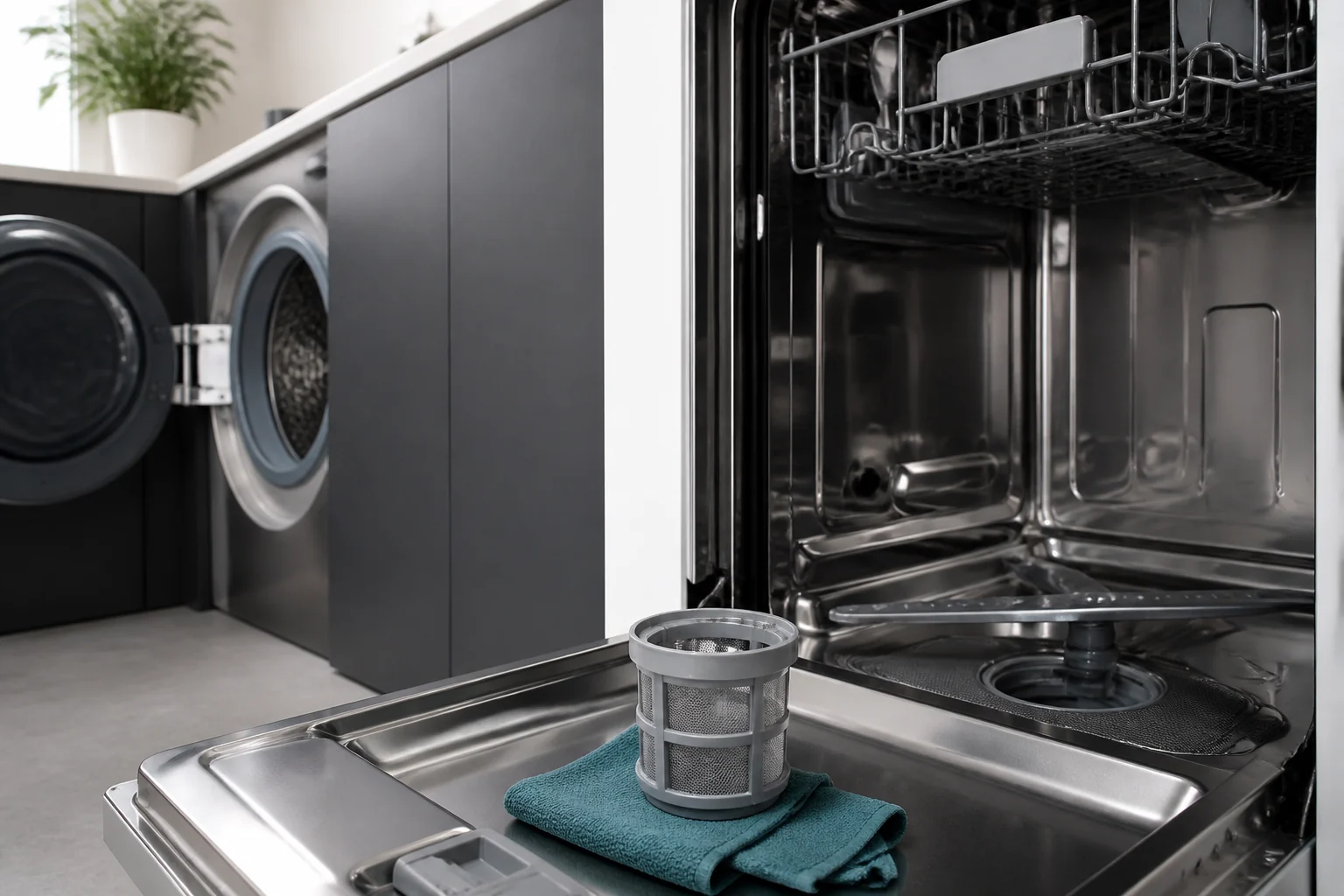
A clean-looking appliance door does not prove the internal system is clean. Filters collect debris, seals retain moisture, detergent components can accumulate, grease reaches hidden dishwasher surfaces and minerals can deposit on heated areas. Good maintenance separates accessible mechanical cleaning from an approved empty-machine treatment.
Start with the appliance manual
Filter access, drain procedures, cleaning programmes and permitted products vary. Disconnect or isolate an appliance where the manufacturer requires it before manual cleaning. Never dismantle parts beyond the user-maintenance instructions.
Washing machine maintenance zones
- Detergent drawer: product residue and standing moisture.
- Door seal: trapped fibres, small objects and moisture.
- Drain-pump filter: accessible debris where the manual provides user access.
- Drum and internal circuit: residues addressed by the machine’s maintenance programme and an approved treatment.
Dishwasher maintenance zones
- Filter assembly: food debris and grease. Bosch advises removing and gently cleaning the filter, including using a small brush for fine debris.
- Spray arms: blocked openings can affect water distribution; inspect only as the manual directs.
- Door edges and seals: wipe accessible areas without flooding controls.
- Internal sump and hidden circuit: use the specified maintenance cycle and suitable product.
A controlled monthly check
- Read the manual.Locate approved filters, seals and maintenance programmes.
- Remove loose debris manually.Chemistry should not be expected to dissolve coins, labels, glass or food pieces.
- Clean user-serviceable filters.Rinse and brush as instructed, then refit securely.
- Inspect seals and dispensers.Use a soft cloth and compatible method.
- Run the approved treatment.Use the correct Modulus appliance product for the correct machine—never both together.
- Record the date.Adjust frequency around use, water hardness and the manufacturer’s guidance.
Diagnose the symptom before the cycle
Odour indicates retained contamination or moisture but does not locate it. Inspect filters, seals, dispensers and drainage paths identified as user-serviceable. Visible scale suggests a mineral component, but compatibility still applies. Poor washing performance may relate to loading, flow or blocked filters—and maintenance chemistry cannot repair a failed heater, pump or sensor.
Maintenance is a system
Filters handle physical debris, correct dosing limits unnecessary residue, appropriate programmes manage heat and flow, and a machine-specific treatment addresses deposits within its stated scope. Keep a simple date record. If maintenance is needed more often, investigate what changed: use frequency, cool programmes, detergent, loading or water conditions.
14 Dishwasher + 15 Washing Machine
Different deposits, different chemistry. Choose the product designed for the machine being maintained.
What not to do
- Do not combine an appliance cleaner with bleach, descaler or another household product.
- Do not run a maintenance chemical with laundry or dishes unless explicitly instructed.
- Do not assume a dishwasher and washing machine use interchangeable chemistry.
- Do not force a filter or panel that the user manual does not identify as removable.
- Do not use extra product to compensate for skipped mechanical cleaning.
Frequently asked questions
How often should I clean an appliance?
There is no universal interval. Follow the manufacturer’s guidance and adjust for frequency of use, low-temperature programmes, visible residue, odour and local water conditions.
Will an empty hot cycle solve every problem?
No. Mechanical debris in filters must be removed, and the appliance may specify a particular programme or product.
Why does my dishwasher still smell after a cleaner?
Check the filter, trapped debris, drain conditions and spray system according to the manual. A chemical treatment cannot correct a mechanical fault.
Technical basis
See Bosch guidance on cleaning a dishwasher filter. Machine-specific instructions and the final Modulus label take priority.
RELEVANT PRODUCTS
Match the chemistry to the job.
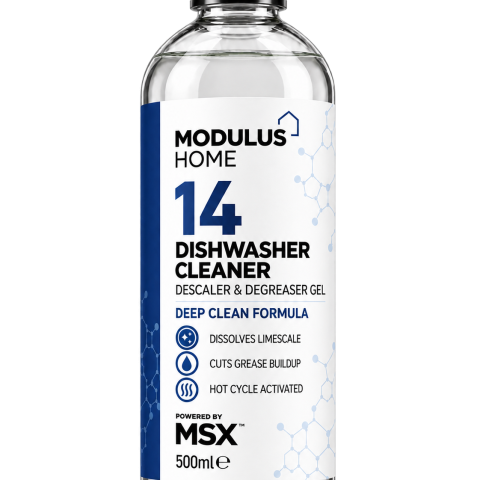
14 Dishwasher Cleaner
A 500ml periodic dishwasher maintenance cleaner for grease, residue and internal machine build-up.
£6.99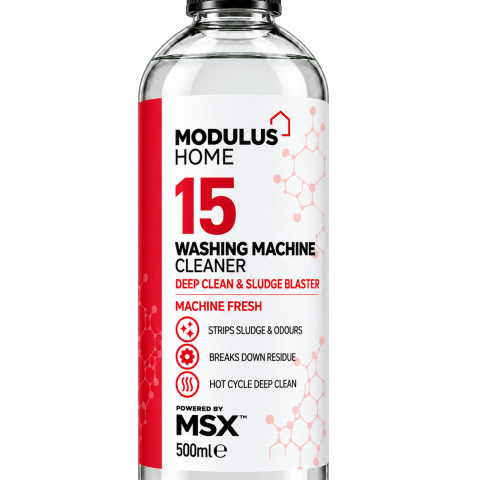
15 Washing Machine Cleaner
A 500ml periodic washing-machine maintenance cleaner for detergent residue, soils and mineral deposits.
£6.99Always read the product label, confirm surface compatibility, ventilate as directed, keep products away from children and pets, and never mix household cleaners.