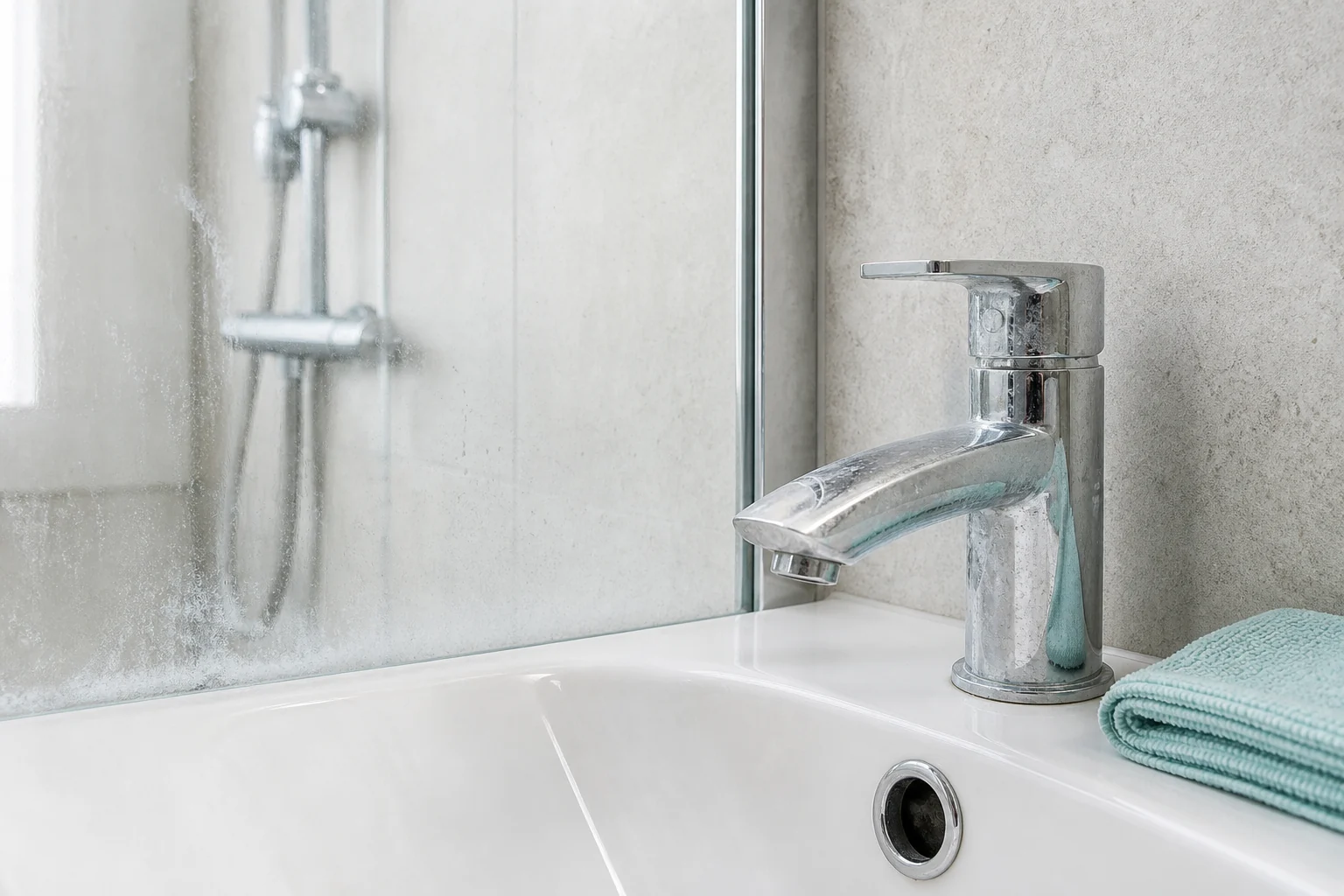
The pale film around taps and shower screens is often described as “limescale”, but bathrooms commonly contain overlapping deposits: mineral scale from hard water, soap-derived residues, body oils and ordinary particulate soil. Correct identification matters because a treatment aimed at minerals may not remove the oily component—and an acidic approach can damage incompatible materials.
What is limescale?
Water hardness is primarily associated with dissolved calcium and magnesium. As water evaporates or is heated, mineral deposits can remain on fixtures, glass and heating surfaces. The US Geological Survey classifies water above 180 mg/L as calcium carbonate as very hard and notes that hard water contributes to scale formation.
What is soap scum?
Soap scum is a more complex deposit. Traditional soap can react with hardness minerals to form poorly soluble residues. In a shower, this may combine with body oils, product residue and fine dirt. The result can feel waxier or greasier than a dry, chalk-like mineral deposit.
A safe diagnosis sequence
- Look at the location.Scale concentrates where water repeatedly evaporates: tap bases, screen edges and spray paths.
- Assess the texture.Dry chalkiness suggests a strong mineral component; greasy cloudiness suggests a mixed film.
- Identify the material.Chrome, ceramic, glass, grout, natural stone and plated finishes cannot be treated as one surface.
- Read the product label.Confirm both the deposit and surface are within scope.
- Test discreetly.Use a small inconspicuous area, the stated contact time and no improvised mixtures.
04 Bathroom
Bathroom-specific chemistry designed for compatible surfaces affected by limescale, soap scum and everyday bathroom soil.
How to clean compatible bathroom surfaces
Begin with a cool surface. Remove loose hair and debris. Apply the product according to its label and keep coverage controlled. Allow only the stated contact time—longer is not automatically better. Agitate where directed with a non-scratching cloth or suitable pad, then rinse or wipe thoroughly. Drying the surface helps reveal remaining mineral boundaries.
Shower glass
Work in manageable sections and rinse edges, seals and fittings. Mineral deposits can overlap with product films, so a second controlled pass may be more effective than aggressive abrasion.
Chrome and plated finishes
Do not leave chemistry sitting beyond the label time. Rinse and dry. A finish that already has pitting or coating failure requires extra caution.
Natural stone and acid-sensitive surfaces
Many mineral removers use acidic chemistry, which may etch calcium-based stone. Never infer compatibility from the word “bathroom”. Seek surface-specific confirmation.
Prevention is a water-management problem
- Squeegee shower glass after use to reduce evaporation marks.
- Dry standing water around tap bases.
- Use the correct product dose; excess wash product can contribute additional film.
- Clean light deposits regularly instead of waiting for a thick composite layer.
- Check local water-hardness information when dosing laundry and dishwashing products.
Frequently asked questions
Is white vinegar always safe for limescale?
No. An acid may attack acid-sensitive stone, grout components, plated finishes or other materials. Surface compatibility still applies, and improvised mixtures should be avoided.
Why does scale return quickly?
The mineral source remains in the water. Cleaning removes the deposit, not the hardness. Reducing standing droplets and cleaning before heavy build-up can make control easier.
Can limescale remover be mixed with bleach?
No. Never mix household cleaners. Mixing products can produce dangerous gases.
Technical basis
Water-hardness descriptions are based on the US Geological Survey. Safety guidance is supported by the NHS. Always follow the final product label.
RELEVANT PRODUCT
Match the chemistry to the job.
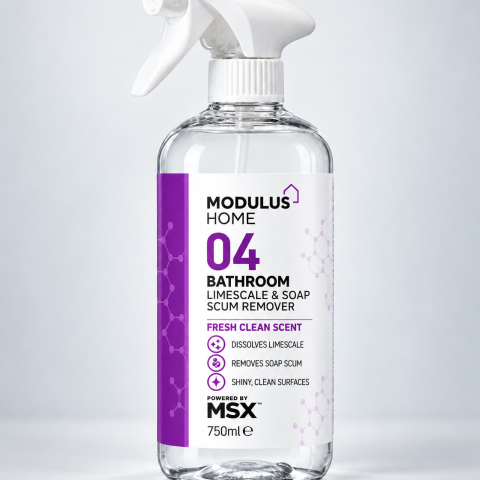
04 Bathroom
Bathroom-specific cleaning for limescale, soap residue and everyday bathroom soils on compatible washable surfaces. Available ready to use, as a product-matched concentrate, or together.
£6.99Always read the product label, confirm surface compatibility, ventilate as directed, keep products away from children and pets, and never mix household cleaners.