
Laundry dose is part of the formulation system. Too little can leave insufficient chemistry for the soil and water conditions. Too much can increase foam, complicate rinsing, waste product and contribute to residue. The correct number is the approved label dose adjusted only within the product’s instructions.
What changes the required dose?
Use the label as the controlled starting point
Do not transfer a dose from another detergent. Two liquids with similar appearance may contain different concentrations and dosing systems. Find the product-specific dose, identify the load band and measure it with a marked device. Our Dose & Dilution Calculator can calculate uses per bottle and refill timing from the approved label dose.
A practical dosing sequence
- Sort by care label and colour.The garment label and machine programme remain the primary controls.
- Estimate dry load accurately.Do not compress an overloaded drum; mechanical movement contributes to cleaning.
- Assess contamination.Everyday wear, particulate soil and oily food stains present different demands.
- Check local water hardness.Your water supplier can provide local data. Use only the corresponding label band.
- Measure the dose.Use millilitres, not an unmarked visual guess.
- Review the result.Persistent odour, residue or foam is diagnostic information—not an instruction to keep adding detergent.
06 Laundry
Concentrated non-biological laundry chemistry designed around modern surfactant systems.
Why water hardness matters
Hardness is mainly associated with calcium and magnesium. The US Geological Survey notes that hard water consumes soap and contributes to scale. Modern detergents can include builders and other components that manage water conditions, but the approved dose still needs to account for the product and local hardness band.
Signs worth investigating
Excessive foam
Possible contributors include overdose, a low-soil load or a product/programme mismatch. Appliance guidance commonly recommends checking the detergent quantity.
White or stiff residue
Consider dose, drum loading, rinse performance, water hardness and whether incompatible products have accumulated.
Odour after washing
Investigate load drying, machine maintenance, programme temperature, drum loading and contamination type rather than masking the issue with more fragrance.
Separate stain treatment from wash dosing
A heavily stained item does not automatically justify increasing the dose for every garment. Where the instructions allow, targeted pre-treatment can address local contamination while the main dose remains appropriate for the load. Avoid drying or ironing a stain until removal is confirmed because heat can make some remaining contamination harder to remove.
Make dosing auditable at home
Record dry load size, measured dose and result for several washes. This is more useful than repeatedly changing several variables together. Obtain the current hardness band from the water supplier rather than guessing from kettle scale alone. Use the calculator to predict uses per bottle, then compare that prediction with actual purchase frequency.
Frequently asked questions
Does concentrated detergent mean I should use more?
No. Concentration normally means a smaller volume can deliver the intended chemistry. Use the stated dose.
Can I pre-treat every stain with detergent?
Only where the product and garment instructions permit it. Test colourfastness and avoid drying a stain before confirming removal.
Is more foam better cleaning?
No. Foam is visible behaviour, not a direct measure of soil removal.
Technical basis
See the Royal Society of Chemistry’s detergent overview and USGS water-hardness guidance. Follow garment, machine and final product instructions.
RELEVANT PRODUCT
Match the chemistry to the job.
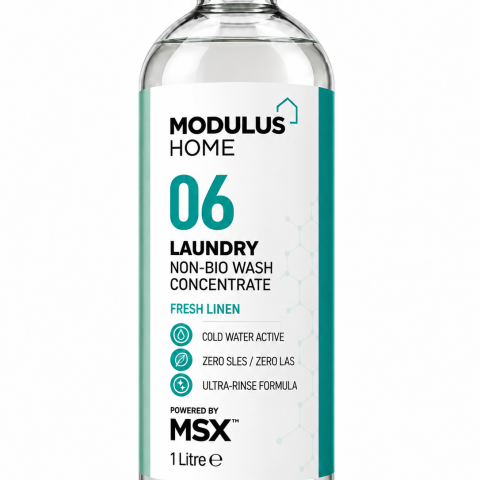
06 Laundry - Non Bio Laundry Detergent
A concentrated non-biological laundry detergent for measured machine washing across everyday loads. The 1 litre format keeps dosing controlled rather than perfume-led.
£11.99Always read the product label, confirm surface compatibility, ventilate as directed, keep products away from children and pets, and never mix household cleaners.